This post may contains Amazon affiliate and other affiliate links. If you make a purchase through these links, I may earn a small commission at no extra cost to you. Your support helps me continue to provide quality content. I only recommend products I personally trust and believe will add value to your experience. For more details, please visit my Privacy Policy.
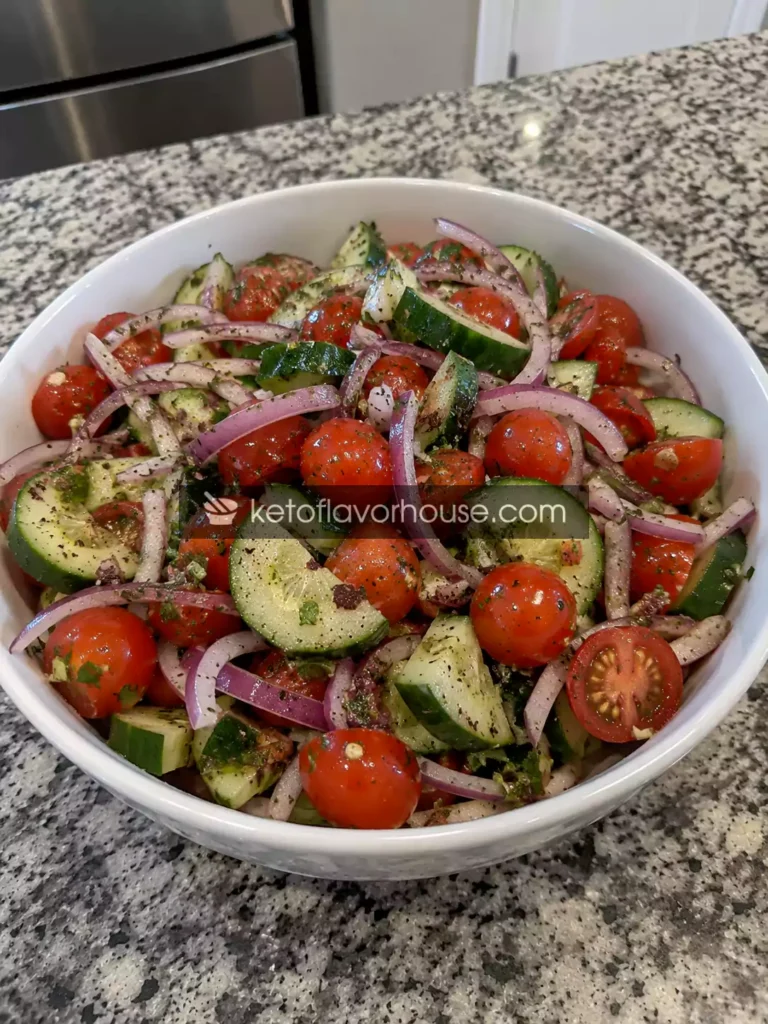
There are days when I want a salad that tastes fresh and colorful but doesn’t require me to pull out a dozen ingredients or spend half an hour standing over the stove. That’s exactly where this Mediterranean Pickled Cherry Tomato, Red Onion & Cucumber Salad comes in. Juicy cherry tomatoes, crisp cucumber, thinly sliced red onion, fresh herbs, garlic, lemon, red wine vinegar, and extra-virgin olive oil come together in a bright, tangy dressing that gets even better after a short rest.
What makes this salad special is the quick-pickling element. Instead of simply tossing raw vegetables with dressing and serving immediately, the red onion, cucumber, and tomatoes get a little time to soak up the sharp, herby marinade. The vinegar gives everything a pleasant tang, the lemon brightens the flavors, and olive oil softens those sharper edges. After 20 to 30 minutes, the vegetables taste like they’ve been sitting together much longer.
This is a Mediterranean-inspired recipe rather than a claim of one specific traditional dish, but it borrows beautifully from the ingredients and flavor combinations that make Mediterranean-style cooking so appealing: fresh vegetables, olive oil, herbs, garlic, lemon, and vinegar. It’s colorful enough for a summer table, easy enough for a Tuesday night, and versatile enough to serve beside grilled chicken, fish, eggs, lamb, roasted vegetables, or warm flatbread.
And honestly, one of my favorite things about this salad is the texture. You get that juicy little burst from the tomatoes, the refreshing crunch of cucumber, and those soft, tangy ribbons of red onion. It doesn’t feel heavy, but it has enough bold flavor that you won’t find yourself wishing there were something else on the plate.
Why You’ll Love This Recipe
- 🍋 Bright Mediterranean-inspired flavor – Lemon, red wine vinegar, garlic, olive oil, and herbs make every bite lively.
- 🫒 Simple wholesome ingredients – There is no complicated dressing or long ingredient list.
- 🌿 Fresh herbs make it pop – Parsley and dill bring a fresh, aromatic finish.
- 🍅 Beautiful color and texture – Red tomatoes, green cucumber, and purple onion make an effortless centerpiece.
- 🥒 Quick preparation – Most of the work is chopping and whisking.
- 🥗 Great for meal prep – The flavors develop beautifully after resting in the refrigerator.
- 🍽️ Extremely versatile – Serve it with grilled meat, seafood, eggs, grains, dips, or bread.
- ❤️ Easy to share – It works equally well for a family dinner, barbecue, picnic, or casual gathering.
- ✨ No complicated cooking – There is no need to roast or sauté the vegetables.
My Personal Experience
I think every food blogger eventually develops a few recipes that weren’t necessarily planned but become the ones they make over and over again.
This was one of those recipes for me.
I originally wanted something simple to put beside grilled chicken. I had cherry tomatoes sitting on the counter, a cucumber in the refrigerator, and half of a red onion that needed to be used. Normally, I would have chopped everything, added olive oil, lemon juice, salt, and pepper, and called it a salad.
But that day I wanted more flavor.
I sliced the onion thinner than usual, added red wine vinegar, garlic, lemon juice, and herbs, and let everything sit while I finished the rest of dinner.
When I came back to the bowl about half an hour later, the difference was surprisingly noticeable.
The onion had softened just enough to lose its harsh raw bite. The tomatoes had released some of their juices into the dressing, and the cucumber had picked up that tangy, garlicky flavor around the edges while still keeping plenty of its crunch.
I remember thinking, Why don’t I always make it this way?
That’s when this became a regular refrigerator salad for me.
I also learned something important about making it: don’t drown the vegetables in dressing. At first, it can look like there isn’t enough liquid, but the tomatoes release their own juices as they rest. By the time you serve the salad, there is plenty of flavorful liquid at the bottom of the bowl.
And that liquid is absolutely worth spooning over the salad.
It’s one of those little things that makes a simple vegetable salad feel much more special.
Required Equipment
Chef’s Knife
A sharp knife makes this recipe much easier because the vegetables are best when cut cleanly.
You don’t need perfect restaurant-style cuts. In fact, I prefer the salad when the pieces look homemade. Just try to keep the cucumber and tomato pieces reasonably similar in size so you get a little of everything in each forkful.
Cutting Board
You’ll need a stable cutting board for the tomatoes, cucumber, onion, garlic, and herbs.
If you’re preparing everything at once, cut the herbs last. That keeps them looking fresher and prevents them from sitting around on the board while you prepare the other ingredients.
Large Mixing Bowl
Use a bowl large enough to toss the vegetables without crushing the tomatoes.
This is important because the dressing needs to coat everything evenly.
Small Mixing Bowl
A smaller bowl is ideal for whisking the quick-pickling dressing before adding it to the vegetables.
It gives you a chance to taste and adjust the acidity and salt before it reaches the salad.
Whisk
A small whisk helps emulsify the olive oil with the vinegar and lemon juice.
A fork works perfectly well if you don’t have a whisk.
Measuring Cups and Spoons
Accurate measurements are especially helpful for the vinegar, lemon juice, olive oil, and salt.
Once you’ve made the recipe a few times, you can adjust those ingredients more freely according to your taste.
Airtight Storage Container
If you’re making the salad ahead, transfer it to a shallow airtight container.
A shallow container allows the vegetables to sit more evenly in the marinade.
Ingredients & Substitutions
Cherry Tomatoes
400 grams cherry tomatoes
Cherry tomatoes are the star of this salad.
They’re naturally juicy, slightly sweet, and sturdy enough to hold their shape during the quick-pickling process.
I prefer cherry tomatoes because they’re less watery and generally hold up better than very soft tomatoes. You can use grape tomatoes as well.
For larger tomatoes, cut them into bite-sized wedges and remove some of the excess watery seeds if they’re particularly juicy.
Cucumber
1 English cucumber, approximately 300 grams
English cucumber gives the salad its refreshing crunch.
I usually leave the peel on because it adds color and texture. If the skin is particularly thick or waxy, peel it partially or completely.
Regular cucumbers can also be used. If they have large seeds, slice them lengthwise and scoop out some of the seeds before chopping.
Red Onion
1 small red onion, approximately 100 grams
Red onion provides sharpness, color, and a beautiful contrast against the green cucumber and red tomatoes.
Slice it very thinly so the vinegar can soften it quickly.
If raw onion is too strong for you, soak the slices in cold water for 5–10 minutes, drain thoroughly, and then add them to the salad.
Extra-Virgin Olive Oil
3 tablespoons extra-virgin olive oil
Olive oil gives the dressing its smoothness and characteristic Mediterranean-inspired richness.
It also helps carry the flavors of the garlic and herbs throughout the salad.
Use a flavorful olive oil that you enjoy eating. Because the dressing is not cooked, its flavor is noticeable.
Red Wine Vinegar
1/3 cup red wine vinegar
This is the main pickling ingredient.
Red wine vinegar gives the salad a pleasantly sharp acidity that works particularly well with tomatoes, cucumber, and red onion.
If you prefer a gentler flavor, use 1/4 cup instead.
Fresh Lemon Juice
2 tablespoons fresh lemon juice
Lemon adds a brighter, fresher acidity than vinegar alone.
Freshly squeezed lemon makes a noticeable difference here.
Bottled lemon juice can work in a pinch, but fresh lemon is preferable.
Garlic
2 large garlic cloves, finely minced
Garlic adds the savory backbone to the dressing.
Finely mince it so that the flavor spreads throughout the marinade.
If you’re sensitive to raw garlic, start with one clove.
Fresh Parsley
1/4 cup chopped fresh parsley
Parsley gives the salad freshness and a slightly peppery herbal quality.
Flat-leaf parsley works particularly well.
Fresh Dill
2 tablespoons chopped fresh dill
Dill brings a cool, aromatic flavor that pairs naturally with cucumber and lemon.
If you’re not a dill fan, replace it with additional parsley or a little fresh mint.
Dried Oregano
1 teaspoon dried oregano
Oregano gives the dressing a distinctly Mediterranean-style character.
Dried oregano works particularly well here because it has a concentrated flavor that distributes throughout the marinade.
Fine Sea Salt
3/4 teaspoon fine sea salt
Salt helps bring the vegetables’ natural flavors forward and balances the acidity.
Start with this amount and adjust after the salad has rested.
Remember that the vegetables release moisture as they sit, which can slightly change the perceived seasoning.
Freshly Ground Black Pepper
1/2 teaspoon freshly ground black pepper
Black pepper gives the salad a gentle warmth and keeps the dressing from tasting flat.
Add more if you enjoy a stronger pepper flavor.
Optional Sweetener
1 teaspoon honey or maple syrup
This is optional and isn’t necessary if your tomatoes are naturally sweet.
A tiny amount helps round out a very sharp dressing without making the salad sweet.
For a lower-sugar version, use a small amount of a suitable zero-calorie sweetener instead.
How to Make Mediterranean Pickled Cherry Tomato, Red Onion & Cucumber Salad
Step 1: Prepare the Vegetables
Start by washing the cherry tomatoes and cucumber thoroughly.
Dry them well.
This matters more than you might think. Excess water clinging to the vegetables dilutes the marinade.
Halve the cherry tomatoes.
Cut the cucumber into thin half-moons or bite-sized quarter rounds.
Thinly slice the red onion.
You don’t have to make every slice perfectly uniform. The important thing is to keep the cucumber pieces and onion slices reasonably thin so they can absorb the marinade.
Place everything into a large mixing bowl.
Step 2: Prepare the Fresh Herbs
Finely chop the parsley and dill.
For the parsley, gather the leaves into a loose pile and chop them fairly finely.
For the dill, remove any especially tough stems before chopping.
Add the herbs to the bowl with the vegetables.
Don’t worry if some of the herbs cling to your cutting board. That’s completely normal.
Step 3: Make the Mediterranean Pickling Dressing
In a small bowl, whisk together the red wine vinegar, lemon juice, extra-virgin olive oil, minced garlic, dried oregano, salt, and black pepper.
If you’re using honey or another sweetener, add it now.
Whisk until the olive oil is evenly dispersed throughout the vinegar and lemon mixture.
Taste it.
It should be tangy, garlicky, lightly salty, and balanced.
If it tastes extremely sharp, add a tiny bit more olive oil or the optional sweetener.
If it tastes flat, it probably needs a small pinch of salt.
Step 4: Combine the Vegetables and Marinade
Pour the dressing over the tomatoes, cucumber, and red onion.
Use a large spoon or salad tongs to gently toss everything together.
Be careful with the tomatoes.
You want them coated in the dressing, not crushed.
The dressing may initially seem like it isn’t enough.
Don’t add extra immediately.
The tomatoes will release some juice as the salad rests, creating additional liquid and flavor.
Step 5: Let the Salad Quick-Pickle
Cover the bowl and refrigerate the salad for at least 20–30 minutes.
This is the most important resting period.
The vinegar and lemon begin working on the vegetables, especially the red onion.
The onion becomes slightly softer and less sharp, while the cucumber and tomatoes absorb some of the garlicky, herby marinade.
For an even deeper flavor, you can let it rest for up to 2 hours before serving.
I wouldn’t leave it at room temperature for an extended period.
Step 6: Taste and Adjust
After resting, give the salad another gentle toss.
Taste a cucumber slice, a tomato, and a little onion together.
This is the moment to adjust the seasoning.
If it needs more brightness, add a teaspoon of lemon juice.
If it needs more richness, add a small drizzle of olive oil.
If the vinegar feels too aggressive, add a tiny amount of sweetener.
If the flavors seem muted, add a small pinch of salt.
Don’t make major adjustments all at once. Small additions are much easier to control.
Step 7: Finish With Fresh Herbs
Right before serving, add a little extra chopped parsley or dill if desired.
Fresh herbs added at the end give the salad a particularly vibrant aroma.
You can also finish with a tiny drizzle of extra-virgin olive oil.
Step 8: Serve
Transfer the salad to a serving bowl or platter.
Spoon some of the flavorful marinade from the bottom over the top.
Serve chilled or slightly cool.
The salad is particularly good alongside grilled chicken, fish, lamb, roasted vegetables, or warm bread.
And don’t forget the liquid at the bottom.
That’s where all those tomato juices, garlic, herbs, lemon, and vinegar come together.
Common Mistakes to Avoid
Cutting the Onion Too Thick
Thick onion pieces can remain aggressively sharp even after resting.
Fix: Slice the red onion very thinly.
If necessary, soak it briefly in cold water before adding it to the salad.
Adding Too Much Dressing
It can be tempting to add more vinegar because the salad looks dry at first.
Fix: Start with the specified amount and wait.
The tomatoes naturally release juice, which increases the amount of liquid in the bowl.
Not Drying the Vegetables
Water left on the vegetables dilutes the dressing.
Fix: Pat the tomatoes and cucumber dry after washing.
Crushing the Tomatoes
Aggressive tossing can break the tomatoes apart.
Fix: Use a gentle folding motion with salad tongs or a large spoon.
Skipping the Resting Time
You can technically eat the salad immediately, but the flavors won’t be as developed.
Fix: Give it at least 20–30 minutes.
Over-Salting at the Beginning
The vegetables release water during the resting period, which can change the seasoning.
Fix: Start with the measured salt and adjust after resting.
Using Too Much Dried Oregano
Oregano is powerful.
Too much can make the dressing taste dusty or bitter.
Fix: Keep it to about one teaspoon.
Adding Fresh Herbs Too Early
Fresh herbs can lose some of their vibrant appearance when left sitting in acidic dressing for a long time.
Fix: Add a little extra fresh parsley or dill right before serving.
Pro Tips for Best Results
The quality of your vegetables makes a huge difference in a recipe this simple.
Choose firm cherry tomatoes with smooth skins and a fresh cucumber with plenty of crunch.
You don’t need expensive ingredients. You simply want ingredients that taste good on their own.
Another useful trick is to slice the onion first.
Add it to the vinegar and lemon dressing for a few minutes while you prepare the rest of the vegetables. This gives the onion a head start on softening.
For maximum flavor, finely mince the garlic rather than chopping it into large chunks.
The smaller pieces distribute more evenly throughout the dressing.
I also recommend using fresh lemon juice.
The lemon is one of the flavors you notice immediately, and fresh juice gives the dressing a much cleaner brightness.
If you’re serving this salad at a gathering, make it about an hour before dinner. That gives the vegetables enough time to absorb the dressing while keeping the cucumber relatively crisp.
Mediterranean Benefits of Tomatoes
Tomatoes are a natural fit for Mediterranean-style cooking because they’re versatile, fresh, colorful, and easy to combine with olive oil, herbs, garlic, and acidic ingredients.
In this salad, cherry tomatoes provide more than color.
Their natural sweetness balances the sharpness of red wine vinegar and red onion. As they rest, their juices mingle with the dressing, creating a naturally tomato-infused marinade.
Tomatoes also contribute vitamin C, potassium, fiber, and naturally occurring plant compounds as part of an overall varied diet.
Their juicy texture is particularly useful in salads because they help create a flavorful dressing without requiring a large amount of additional liquid.
That is exactly why I don’t recommend pouring in extra vinegar simply because the bowl looks dry when you first combine everything.
Give the tomatoes time to do their thing.
Variations You Can Try
🌶️ Spicy Mediterranean Version
Add 1/2 teaspoon red pepper flakes to the dressing.
For more heat, add a finely chopped fresh chili.
The spicy version is fantastic with grilled chicken, shrimp, or grilled vegetables.
🌿 Extra-Herby Version
Increase the parsley to 1/3 cup and add another tablespoon of dill.
You can also add a tablespoon of chopped fresh mint.
This version tastes especially refreshing in warm weather.
🧄 Garlic-Lover’s Version
Use three garlic cloves instead of two.
Finely grate one clove into the dressing and mince the remaining two.
The result is much more intensely savory.
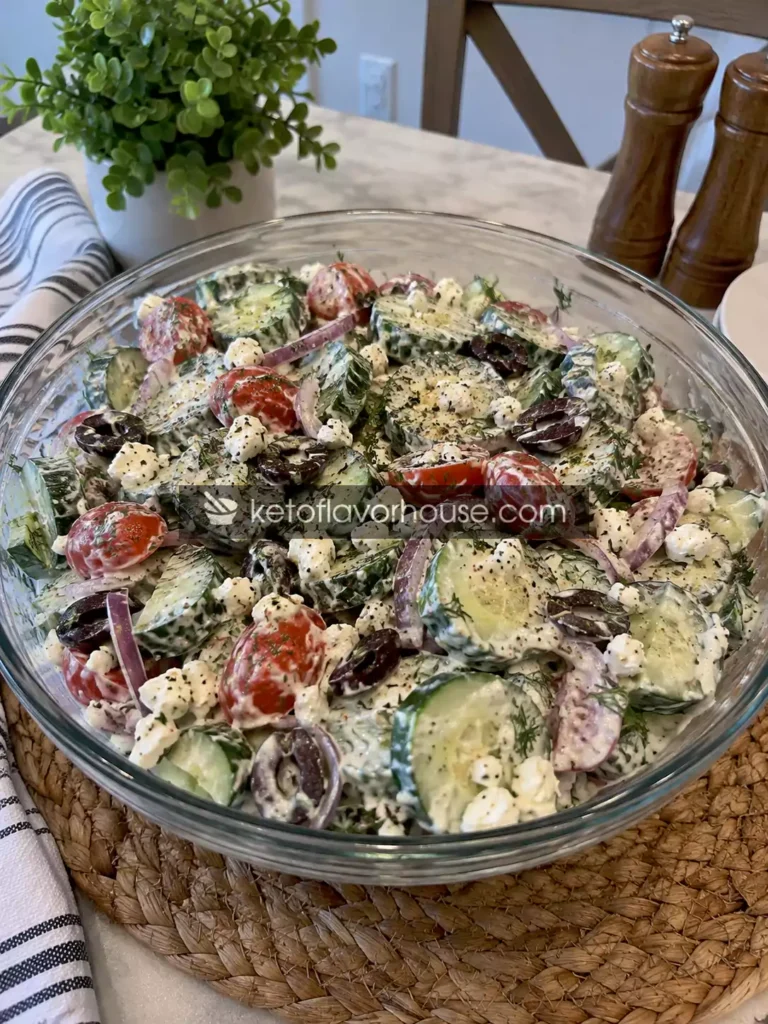
🧀 Feta Version
Add 75 grams crumbled feta cheese just before serving.
The salty, creamy feta works beautifully with the acidic vegetables.
Because feta is already salty, taste the salad before adding any additional salt.
🍋 Lemon-Herb Version
Reduce the red wine vinegar to 1/4 cup and increase the fresh lemon juice to 3 tablespoons.
Add extra parsley and dill.
This produces a lighter, more lemon-forward salad.
🫒 Olive Version
Add 60 grams sliced Kalamata olives.
The olives add a salty, briny element that makes the salad feel even more substantial.
Again, adjust the salt carefully because olives can be quite salty.
🥗 Extra Vegetable Version
Add diced bell pepper, thinly sliced radishes, or a small amount of chopped celery.
Bell pepper brings sweetness and crunch, while radishes add peppery freshness.
🔥 Grilled Version
For a different texture, grill the cucumber and red onion briefly before cooling them and tossing them with the tomatoes.
The tomatoes can also be quickly grilled on skewers.
This creates smoky edges and turns the salad into a warmer side dish.
💨 Air Fryer Version
This isn’t necessary for the original recipe, but you can air-fry halved cherry tomatoes and sliced red onion at approximately 375°F (190°C) for 5–7 minutes until lightly softened.
Cool them before combining with the cucumber and dressing.
This variation is no longer the same crisp quick-pickled salad, but it creates an interesting warm-and-cool combination.
Tips for This Recipe
For the crispest cucumber, don’t cut it too far in advance.
If you’re making the salad several hours ahead, keep the cucumber separate and combine it closer to serving time.
If you want the strongest pickled onion flavor, slice the onion very thinly and let it sit in the dressing before adding the other vegetables.
For entertaining, prepare the dressing several hours ahead and refrigerate it separately.
Then chop the vegetables closer to serving.
This keeps everything especially fresh.
If the finished salad has too much liquid after resting, don’t drain it immediately.
Taste it first.
That liquid contains tomato juice, olive oil, vinegar, garlic, lemon, and herbs, and it’s one of the best parts of the recipe.
If you do need to reduce the liquid for serving on a platter, use a slotted spoon to transfer the vegetables rather than pressing or squeezing them.
Optional Additions
There are plenty of ways to customize this salad without losing its Mediterranean-inspired character.
Try adding:
- Fresh mint
- Extra parsley
- Fresh oregano
- Kalamata olives
- Crumbled feta
- Lemon zest
- Red pepper flakes
- Thinly sliced bell pepper
- Radishes
- Toasted pine nuts
- Toasted almonds
- Avocado
- A spoonful of hummus
- A drizzle of tahini
- A little Greek yogurt on the side
A small amount of lemon zest is one of my favorite additions because it gives the salad a fresh citrus aroma without adding extra liquid.
If adding nuts, sprinkle them over the salad immediately before serving so they stay crunchy.
Serving Ideas
This salad is one of those side dishes that seems to work with almost everything.
Serve it alongside grilled chicken for an easy Mediterranean-inspired dinner.
It’s also excellent with grilled fish or shrimp because the acidity cuts through the richness of the protein.
For a vegetarian meal, serve it alongside hummus, warm pita, roasted chickpeas, grilled vegetables, and a spoonful of Greek yogurt.
For a lighter lunch, pile the salad over mixed greens and add feta, boiled eggs, or grilled chicken.
During summer, put a large bowl on the table alongside grilled meats and let everyone help themselves.
It’s also a great choice for casual entertaining because it can be prepared ahead and doesn’t need to be served piping hot.
For a Mediterranean dinner night, I love serving it with:
- Grilled chicken
- Hummus
- Warm flatbread
- Roasted vegetables
- Feta
- Olives
- Lemon wedges
- A simple yogurt or tahini sauce
The salad also makes a beautiful addition to a holiday table because the colors are naturally vibrant.
Storage Recommendations
Refrigerator
Store leftovers in an airtight container in the refrigerator for approximately 2–3 days.
The flavor will continue developing, but the cucumber will gradually become softer.
For the best texture, I prefer eating it within the first 24 hours.
Make-Ahead Storage
If you’re preparing the salad for a gathering, you can make the dressing up to 1 day ahead.
Store the dressing separately.
Prepare the vegetables several hours before serving, then combine everything about 30–60 minutes before the meal.
This provides the best balance between flavor development and crisp texture.
Freezer
I don’t recommend freezing this salad.
Cucumber and tomatoes contain a lot of water, and freezing them causes their cell structure to break down.
After thawing, the vegetables become soft and watery.
The fresh crunch is one of the main reasons this recipe is so good, so refrigeration is the better option.
Reheating
There is no need to reheat this salad.
Serve it chilled or allow it to sit at room temperature briefly before serving.
If you’ve made the grilled variation, you can gently warm the grilled vegetables separately before combining them with the fresh cucumber.
Frequently Asked Questions
Can I make this salad ahead of time?
Yes, and the flavor actually benefits from a short resting period.
For the best texture, prepare it about 20–60 minutes before serving. If you need to prepare it much earlier, keep the dressing separate and combine it with the vegetables closer to mealtime.
How do I keep the cucumber from becoming soggy?
Start with a firm, fresh cucumber and don’t cut it excessively thin.
Also, avoid letting the salad sit in a large amount of dressing for many hours. For meal prep, store the dressing separately and combine it shortly before eating.
Can I use regular cucumbers instead of English cucumbers?
Absolutely.
If your regular cucumbers have large seeds, cut them lengthwise and scoop out some of the watery center.
Then slice the cucumber into half-moons or bite-sized pieces.
Can I use dried herbs instead of fresh?
Yes, but fresh herbs are preferable.
If substituting dried herbs, use smaller quantities because dried herbs are more concentrated. For parsley, you can use about 1 tablespoon dried in place of the fresh parsley, although the finished salad won’t have quite the same fresh appearance.
Dried dill can also be used, but start with approximately 2 teaspoons and adjust to taste.
Can I add feta cheese?
Definitely.
Add approximately 75 grams crumbled feta right before serving.
Since feta is salty, taste the salad first and adjust the salt afterward.
The combination of tomato, cucumber, red onion, feta, olive oil, and herbs is particularly delicious.
Can I make this salad spicy?
Yes.
Red pepper flakes are the easiest option. Start with 1/2 teaspoon and increase from there.
You can also add thinly sliced fresh chili or a pinch of ground Aleppo-style pepper if you have it.
Can I grill the vegetables?
Yes, although grilling changes the character of the salad.
Briefly grill the tomatoes and red onion, allow them to cool, and then combine them with the fresh cucumber and Mediterranean-inspired dressing.
You’ll get smoky, lightly caramelized flavors alongside the crisp cucumber.
Can I freeze this salad?
I don’t recommend freezing it.
The cucumber and tomatoes become soft and watery after thawing.
This is best treated as a fresh refrigerator salad.
What can I serve with this salad?
It pairs beautifully with grilled chicken, fish, shrimp, lamb, hummus, feta, roasted vegetables, flatbread, rice, couscous, or chickpeas.
For a lighter meal, add grilled chicken or boiled eggs directly to the salad.
Can I make it without garlic?
Yes.
Simply omit the garlic.
You’ll lose some of the savory depth, but the lemon, vinegar, olive oil, herbs, and vegetables still provide plenty of flavor.
You can add extra fresh dill or parsley to compensate.
Why is my dressing too sour?
Red wine vinegar can vary significantly in sharpness.
If the dressing tastes too acidic, whisk in another tablespoon of olive oil or add a small amount of honey or another sweetener.
Don’t add a large amount at once. A tiny adjustment can make a surprisingly big difference.
Nutritional Breakdown Per Serving
The following values are estimated for 1 of 6 servings of the basic salad and do not include optional feta, olives, nuts, or other additions.
- Calories: approximately 145 kcal
- Protein: approximately 2.5 g
- Fat: approximately 10 g
- Total Carbohydrates: approximately 10 g
- Fiber: approximately 2 g
- Net Carbohydrates: approximately 8 g
- Sugar: approximately 5 g
- Sodium: approximately 500 mg
Nutritional values are estimates and can vary depending on the exact size of the vegetables, olive oil, vinegar, and other ingredients used.
Adding feta, olives, nuts, or additional olive oil will change the nutritional values.
Recipe Snapshot
Prep Time: 15 minutes
Cook Time: 0 minutes
Marinating Time: 30 minutes
Total Time: 45 minutes
Course: Salad / Side Dish
Cuisine: Mediterranean-inspired
Servings: 6
Calories: ~145 per serving
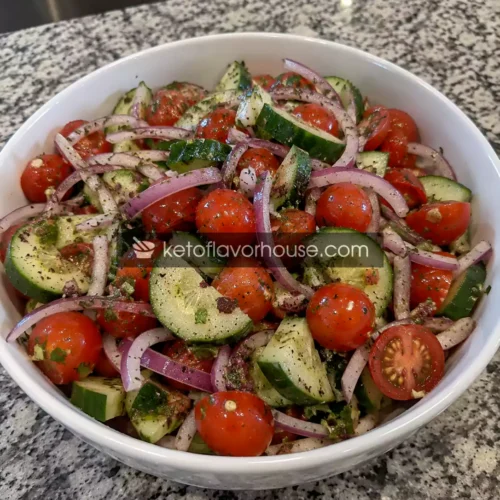
Mediterranean Pickled Cherry Tomato, Red Onion & Cucumber Salad

Ingredients
- 400 g cherry tomatoes halved
- 1 English cucumber about 300 g, sliced
- 1 small red onion about 100 g, thinly sliced
- 3 tbsp extra-virgin olive oil
- 1/3 cup red wine vinegar
- 2 tbsp fresh lemon juice
- 2 large garlic cloves finely minced
- 1/4 cup fresh parsley chopped
- 2 tbsp fresh dill chopped
- 1 tsp dried oregano
- 3/4 tsp fine sea salt
- 1/2 tsp freshly ground black pepper
- 1 tsp honey or maple syrup optional
Instructions
- Wash and thoroughly dry the cherry tomatoes and cucumber. Halve the cherry tomatoes, slice the cucumber into thin half-moons or bite-sized pieces, and thinly slice the red onion. Place all three vegetables in a large mixing bowl.
- Finely chop the fresh parsley and dill, then add both herbs to the bowl with the vegetables.
- In a separate small bowl, whisk together the extra-virgin olive oil, red wine vinegar, fresh lemon juice, minced garlic, dried oregano, sea salt, and black pepper. Add the optional honey or maple syrup if you want to slightly soften the acidity.
- Pour the dressing over the vegetables and herbs. Gently toss with salad tongs or a large spoon until the tomatoes, cucumber, and onion are evenly coated without crushing the tomatoes.
- Cover the bowl and refrigerate for at least 20–30 minutes to allow the vegetables to absorb the tangy dressing and the red onion to soften slightly.
- Remove the salad from the refrigerator and gently toss again. Taste and adjust the seasoning with a little extra lemon juice, olive oil, salt, or sweetener if needed.
- Add a little extra fresh parsley or dill just before serving, if desired, and spoon some of the flavorful marinade from the bottom of the bowl over the vegetables.
- Serve chilled or slightly cool as a side dish with grilled chicken, fish, shrimp, lamb, hummus, flatbread, roasted vegetables, or your favorite Mediterranean-inspired meal.