This post may contains Amazon affiliate and other affiliate links. If you make a purchase through these links, I may earn a small commission at no extra cost to you. Your support helps me continue to provide quality content. I only recommend products I personally trust and believe will add value to your experience. For more details, please visit my Privacy Policy.
Introduction
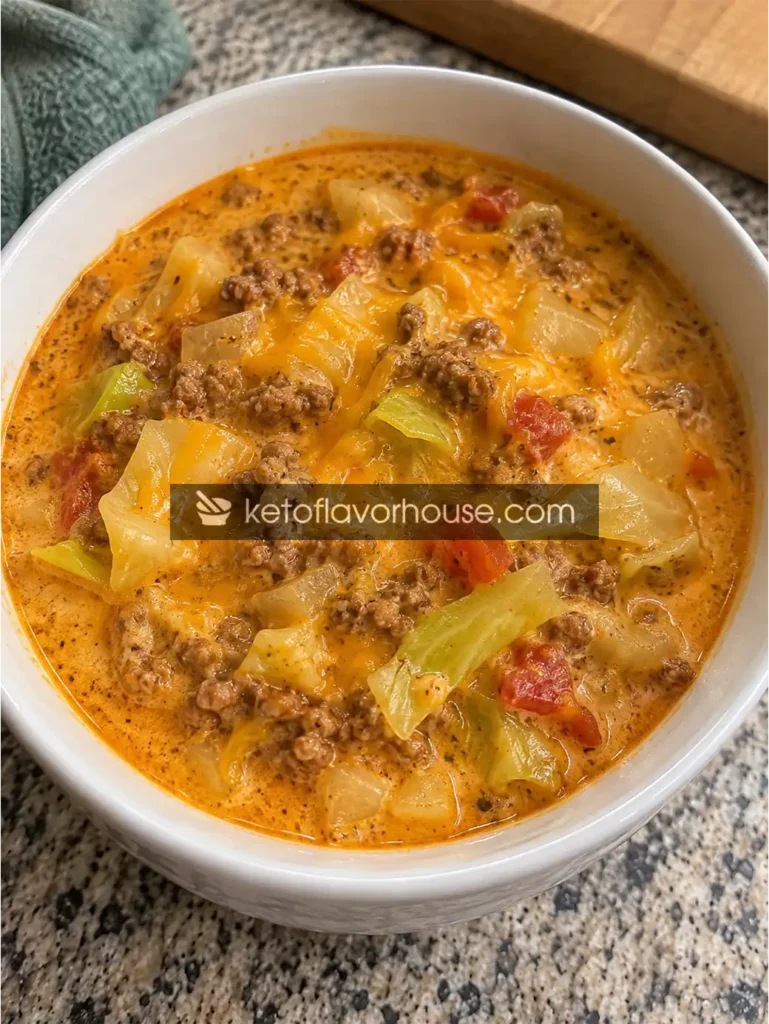
There is something incredibly satisfying about a warm bowl of homemade soup, especially when the weather turns cold and you’re craving something hearty. This Keto Low-Carb Cheesy Beef & Cabbage Soup combines everything I enjoy about comfort food: savory ground beef, tender cabbage, a flavorful tomato-infused broth, and plenty of creamy melted cheese.
Traditional beef and cabbage soups can be delicious, but many versions rely on potatoes, flour, or other higher-carbohydrate ingredients to make them more filling. This recipe takes a different approach. Ground beef provides a substantial protein base, cabbage adds texture and volume, and a combination of cream cheese, heavy cream, and cheddar creates a rich, velvety broth without needing a flour-based thickener.
What makes this soup particularly appealing is the way the ingredients come together. The ground beef is browned first to develop a deep, savory flavor. Garlic, onion, paprika, and Italian seasoning build additional layers of taste, while the cabbage softens in the beef broth. Cream cheese and cheddar are added toward the end, transforming the broth into a creamy, cheesy soup that feels much more indulgent than its simple ingredients suggest.
It’s also a practical recipe for busy households. Everything comes together in one large pot, the ingredients are relatively accessible, and leftovers can be refrigerated for convenient lunches and dinners. Whether you’re following a ketogenic diet, reducing carbohydrates, or simply looking for a different way to prepare ground beef, this soup deserves a place in your recipe rotation.
Recipe at a Glance
Here is a quick overview of the ingredients, preparation time, and estimated nutritional profile.
🥣 Keto Cheesy Beef & Cabbage Soup
Preliminary estimates based on the ingredient quantities below. Final nutrition depends on product labels and portion sizes.
Why You’ll Love This Keto Low-Carb Cheesy Beef & Cabbage Soup
This isn’t just another ground beef soup. The combination of browned beef, tender cabbage, and creamy cheese creates a satisfying meal with several practical advantages.
- Rich and cheesy: Cream cheese, heavy cream, and cheddar give the broth a smooth, creamy consistency.
- Low-carb ingredients: Cabbage replaces higher-carbohydrate vegetables such as potatoes, while the broth provides plenty of flavor.
- Protein-rich: Ground beef and dairy ingredients contribute a substantial amount of protein.
- One-pot preparation: You can brown the beef, cook the vegetables, and finish the soup in the same pot.
- Family-friendly: The familiar flavors of beef and cheddar make this a comfortable dinner option even for people who aren’t following keto.
- Meal-prep friendly: Prepare a large batch and refrigerate individual portions for convenient meals.
- Easy to customize: Add mushrooms, spinach, extra herbs, or a little chili for a different flavor.
One of the biggest advantages is that cabbage becomes wonderfully tender as it simmers in the broth. It absorbs some of the beef and seasoning flavors while retaining enough texture to make the soup feel substantial.
The cheese is equally important. Rather than simply sprinkling cheddar over the finished soup, incorporating cream cheese and heavy cream into the broth creates a more cohesive, creamy consistency.
My Food Blogger Notes
When putting together a low-carb soup, I think the biggest challenge is creating something that feels like a complete meal rather than a thin broth with a few ingredients floating in it.
Ground beef and cabbage are a particularly useful combination because both ingredients bring something different to the pot. The beef creates a savory foundation, while cabbage adds volume and becomes tender without disappearing completely during cooking.
I particularly like the idea of using two different cheeses rather than relying entirely on cheddar. Cream cheese gives the broth body and a smooth consistency, while cheddar contributes the familiar sharp, cheesy flavor. Heavy cream helps bring everything together.
Another detail worth remembering is the order in which the ingredients are added. Browning the beef first creates more flavor than simply boiling raw ground meat in broth. Adding the cabbage before the dairy also gives it enough time to soften properly.
For serving, I’d keep the presentation simple. A generous ladle of soup in a regular ceramic bowl, with visible ground beef, tender cabbage, and a creamy golden broth, is all this dish needs. It should look like comforting homemade food rather than an elaborate restaurant preparation.
Required Equipment
You don’t need specialized equipment for this soup. A few everyday kitchen tools are sufficient.
Large Dutch Oven or Soup Pot
A heavy-bottomed pot with a capacity of approximately 6–8 quarts is ideal.
It provides enough room to brown the ground beef, sauté the vegetables, and simmer the soup without overflowing.
A Dutch oven also distributes heat more evenly, reducing the chance of the dairy ingredients sticking to the bottom during the final cooking stage.
A regular large stainless-steel soup pot works too.
Sharp Chef’s Knife
A sharp knife makes preparing the cabbage, onion, celery, and garlic much easier.
Cutting the cabbage into relatively uniform pieces helps it soften evenly. Very large pieces can remain tough while smaller pieces become overly soft.
Cutting Board
Use a sturdy cutting board for preparing the vegetables and another board for raw beef if possible.
Always wash and sanitize surfaces and utensils that come into contact with raw ground beef.
Wooden Spoon or Heat-Resistant Spatula
You’ll need this to break the ground beef into smaller pieces, stir the vegetables, and scrape the browned bits from the bottom of the pot.
Those browned bits contain flavor that will eventually dissolve into the broth.
Measuring Cups and Spoons
Accurate measurements are especially helpful when working with broth, cream, and cheese.
The liquid-to-vegetable ratio affects the final consistency, so avoid adding large amounts of extra broth without adjusting the seasoning.
Whisk
A small whisk helps incorporate the softened cream cheese into the broth.
This is useful for preventing lumps and achieving a smoother soup.
Ladle
A ladle makes it easier to distribute the beef, cabbage, and broth evenly between bowls.
Ingredients & Substitutions
This recipe makes six generous servings using ground beef, cabbage, aromatic vegetables, beef broth, and a combination of dairy ingredients.
For the Beef and Vegetable Base
680 g (1½ lb) 85/15 ground beef
Ground beef is the main protein source and gives the soup its hearty, savory character.
I recommend 85/15 ground beef because it provides a useful balance of fat and flavor. The fat also contributes richness to the broth.
You can use 90/10 ground beef if you prefer a leaner soup, although the finished dish will have less fat and may need a little additional butter for richness.
1 tablespoon unsalted butter
Butter helps sauté the aromatic ingredients and adds another layer of richness.
If the beef releases plenty of fat, you may not need the entire tablespoon.
1 medium yellow onion (approximately 100 g), diced
Onion contributes sweetness and savory depth.
Although onion contains carbohydrates, the amount is distributed across six servings. You can reduce it to half an onion if you want to lower the carbohydrate contribution.
3 celery stalks (approximately 120 g), chopped
Celery adds a subtle savory flavor and provides a little crunch before simmering.
It also works well with beef broth and cabbage.
4 garlic cloves, minced
Fresh garlic adds a strong aromatic flavor that complements the beef and cheese.
Add it after the onion and celery have softened to prevent burning.
500 g (approximately 1 lb) green cabbage, chopped
Cabbage is the vegetable that gives this soup its characteristic texture.
It softens as it simmers but retains enough structure to make each spoonful satisfying.
Green cabbage is relatively economical, easy to find, and useful in low-carbohydrate cooking.
1 can (14.5 oz / approximately 411 g) diced tomatoes
Diced tomatoes add acidity, color, and a mild sweetness that balances the richness of the dairy.
Choose plain tomatoes without added sugar. Their carbohydrate contribution should be included in your calculations.
6 cups (1.42 L) low-sodium beef broth
Beef broth forms the liquid base of the soup.
Low-sodium broth is preferable because cheddar, cream cheese, and seasoning can all contribute sodium.
Choose a broth without added sugar or unnecessary carbohydrate fillers.
For the Creamy Cheese Base
113 g (4 oz) full-fat cream cheese
Cream cheese is responsible for much of the soup’s creamy consistency.
Let it soften at room temperature before adding it. Softened cream cheese incorporates more easily into warm broth and is less likely to form lumps.
120 ml (½ cup) heavy whipping cream
Heavy cream gives the soup a richer mouthfeel and helps create a smooth, creamy broth.
Choose unsweetened heavy cream and check the nutrition label.
170 g (approximately 1½ cups) freshly shredded sharp cheddar cheese
Cheddar contributes the recognizable cheesy flavor.
Sharp cheddar works particularly well because its flavor remains noticeable even after being combined with beef broth and cream.
Freshly shredded cheddar is preferable when available because some packaged shredded cheeses contain anti-caking ingredients that can affect melting.
For Seasoning
- 1 teaspoon smoked paprika
- 1 teaspoon dried Italian seasoning
- ½ teaspoon black pepper
- ½ teaspoon salt, or to taste
- 1 tablespoon Worcestershire sauce, optional; check the carbohydrate content of the brand
These seasonings add depth without overwhelming the beef, cabbage, and cheese.
Ingredient Anatomy: What Each Ingredient Does
The balance between the beef, cabbage, broth, and dairy is what gives this soup its characteristic texture.
🥣 Inside the Soup: Ingredient Roles
Provides protein, savory flavor, and a hearty texture.
Adds vegetable volume, fiber, and tender pieces throughout the soup.
Helps create body and a smooth, creamy broth.
Adds richness and softens the sharpness of the cheese.
Provides pronounced cheese flavor and additional protein.
Create the savory liquid base and balance the richness with acidity.
Ingredient Substitution Guide
| Original ingredient | Substitute | What changes |
|---|---|---|
| 85/15 ground beef | 90/10 ground beef | Leaner, less rich broth |
| Green cabbage | Savoy cabbage | More delicate texture |
| Yellow onion | Half the quantity | Lower carbohydrate contribution |
| Cream cheese | Mascarpone | Richer, less tangy flavor |
| Heavy cream | Unsweetened coconut cream | Dairy-free, noticeable coconut flavor |
| Sharp cheddar | Monterey Jack | Milder cheese flavor |
| Beef broth | Unsalted beef stock | Flavor and sodium vary by product |
Important: Not every substitution produces the same nutritional result. Coconut cream, for example, can have a different fat and carbohydrate profile from heavy cream. Always recalculate the recipe using the products you actually purchase.
How to Make Keto Low-Carb Cheesy Beef & Cabbage Soup
The secret to a flavorful soup is building the taste in layers. Start by browning the beef, soften the vegetables, simmer the cabbage in the broth, and add the dairy ingredients toward the end.
Don’t rush the final cheese stage. Gentle heat is important for achieving a creamy consistency without separating the dairy.
Step 1: Prepare the Ingredients
Start by removing the outer leaves of the cabbage and cutting it into quarters.
Remove the hard central core and chop the cabbage into bite-sized pieces. Try to keep the pieces reasonably uniform so they cook at approximately the same rate.
Dice the onion, chop the celery, and mince the garlic.
Take the cream cheese out of the refrigerator approximately 20–30 minutes before cooking. Softened cream cheese is much easier to incorporate into the broth.
Shred the cheddar if you’re using a block rather than pre-shredded cheese.
Having everything prepared before heating the pot makes the cooking process considerably easier.
Step 2: Brown the Ground Beef
Place a large Dutch oven or soup pot over medium-high heat.
Add the ground beef and break it into smaller pieces using a wooden spoon.
Cook for approximately 7–9 minutes, stirring occasionally, until the beef is thoroughly browned.
The meat should develop some golden-brown edges rather than simply turning gray.
Use a food thermometer to verify that ground beef reaches an internal temperature of 160°F (71°C).
If there is a substantial amount of rendered fat, drain some of it, leaving approximately 1 tablespoon in the pot.
This is an important step because excessive grease can make the finished soup feel oily, particularly after adding cream and cheese.
Step 3: Sauté the Onion, Celery, and Garlic
Reduce the heat to medium.
Add the butter to the same pot, followed by the diced onion and chopped celery.
Cook for approximately 4–5 minutes, stirring occasionally, until the onion becomes translucent and the celery begins to soften.
Add the minced garlic and cook for another 30–45 seconds.
Stir continuously during this final stage because garlic can burn quickly.
You should notice a savory aroma developing as the garlic, onion, and browned beef combine.
Step 4: Add the Seasonings and Tomatoes
Add the smoked paprika, Italian seasoning, black pepper, and salt.
Stir thoroughly so the seasonings coat the beef and vegetables.
Next, add the diced tomatoes and optional Worcestershire sauce.
Cook for approximately 2 minutes, stirring occasionally.
The tomatoes will release some moisture and help loosen the browned ingredients from the bottom of the pot.
Scrape up any flavorful browned bits with your wooden spoon.
These small details contribute significantly to the final broth.
Step 5: Add the Beef Broth and Cabbage
Pour in the 6 cups of beef broth.
Stir to combine everything, then add the chopped cabbage.
The cabbage may initially appear to take up a large amount of space. Don’t worry if it looks like the pot is quite full.
As it heats, the cabbage will soften and reduce in volume.
Bring the soup to a gentle boil, then reduce the heat to medium-low.
Cover partially and simmer for approximately 15–20 minutes.
Stir occasionally to ensure the cabbage cooks evenly.
The cabbage should become tender but retain some structure. It shouldn’t dissolve completely into the broth.
Step 6: Add the Cream Cheese
Reduce the heat to low.
Add the softened cream cheese in small pieces.
Stir continuously using a whisk or wooden spoon until the cream cheese begins to dissolve into the hot broth.
If you notice small lumps, continue stirring gently. A whisk can help smooth them out.
Avoid allowing the soup to boil vigorously at this stage.
Cream cheese generally incorporates more smoothly when softened and added gradually rather than placed into the pot as one large cold block.
Step 7: Stir in the Heavy Cream and Cheddar
Pour in the heavy cream and stir gently.
Gradually add the shredded cheddar in small handfuls, allowing each addition to melt before adding more.
Keep the heat low.
The broth should gradually become thicker, creamier, and more uniform in appearance.
If the soup becomes too thick, add a little warm beef broth until it reaches your preferred consistency.
If it seems too thin, allow it to simmer gently for another 2–3 minutes.
Do not boil the soup after adding the dairy ingredients. Excessive heat can cause the cheese to separate and produce a grainy texture.
Step 8: Taste, Adjust, and Serve
Taste the soup and adjust the seasoning.
You may want a little extra black pepper, smoked paprika, or salt.
If the cheese makes the broth too rich, a small splash of additional beef broth can help balance it.
Remove the pot from the heat and allow the soup to rest for approximately 3–5 minutes.
Ladle into bowls while warm.
The finished soup should have tender cabbage, well-seasoned beef, and a creamy cheddar broth that coats the ingredients without becoming excessively thick.
Visual Cooking Guide
The following guide summarizes the main cooking stages so you can follow the process without losing track of the order.
Cooking Process: Eight Simple Stages
Chop cabbage, onion, celery, and garlic. Soften the cream cheese.
Cook for 7–9 minutes until browned and safely cooked.
Cook onion and celery, then briefly add garlic.
Add paprika, Italian seasoning, tomatoes, and Worcestershire sauce.
Add broth and cabbage. Simmer for 15–20 minutes.
Reduce heat and stir until incorporated.
Add heavy cream and cheddar gradually over low heat.
Taste, adjust seasoning, and serve warm.
Can You Make This Soup in a Slow Cooker?
Yes. A slow cooker is useful when you want to prepare the soup earlier in the day and have dinner ready later.
However, I recommend browning the beef separately before transferring it to the slow cooker. This develops better flavor than placing raw ground beef directly into the cooking liquid.
Slow Cooker Instructions
- Brown the ground beef in a skillet and drain excess fat.
- Sauté the onion, celery, and garlic briefly.
- Transfer the beef and vegetables to the slow cooker.
- Add cabbage, diced tomatoes, seasonings, and beef broth.
- Cover and cook on LOW for approximately 5–6 hours or HIGH for approximately 3–4 hours, until the cabbage is tender and the beef mixture is thoroughly hot.
- Stir in softened cream cheese until incorporated.
- Add heavy cream and cheddar gradually.
- Cover and heat on LOW for another 15–20 minutes, stirring occasionally, until the cheese melts.
Slow cookers vary considerably, so check the tenderness of the cabbage and the temperature of the soup rather than relying entirely on the clock.
Can You Make It on the Stovetop Without a Dutch Oven?
Absolutely.
A regular stainless-steel or heavy-bottomed soup pot works well.
The important thing is to maintain a gentle simmer and stir occasionally, especially after the cream cheese and cheddar are added.
Thin-bottomed pots can develop hot spots, making it easier for dairy to stick or scorch.
If your pot heats unevenly, lower the temperature and stir more frequently during the final stage.
Common Mistakes to Avoid
Creamy soups are relatively forgiving, but dairy-based broths require a little attention.
Here are the mistakes most likely to affect this recipe.
1. Adding Cold Cream Cheese Directly to the Soup
Cold cream cheese can form lumps when added to hot broth.
Solution: Allow it to soften first and add it in small pieces over low heat. Whisk gently until smooth.
2. Boiling After Adding the Cheese
High heat can cause cheddar and cream cheese to separate, resulting in an oily or grainy texture.
Solution: Lower the heat before adding dairy. Keep the soup below a vigorous boil.
3. Overcooking the Cabbage
Cabbage can become extremely soft if simmered for too long.
Solution: Start checking after approximately 15 minutes. Stop cooking once it is tender enough to eat but still holds its shape.
4. Making the Soup Too Greasy
Ground beef releases fat during cooking. If all of it remains in the pot, the dairy-rich broth can become excessively oily.
Solution: Drain some of the rendered fat before adding the vegetables and broth, particularly when using 85/15 ground beef.
5. Using Too Much Broth
Adding extra liquid without adjusting the dairy can produce a thinner soup with less pronounced flavor.
Solution: Start with the specified 6 cups. If you need to adjust the consistency, add broth gradually near the end.
6. Adding All the Cheddar at Once
A large quantity of cold cheese can be difficult to incorporate evenly.
Solution: Shred the cheese finely and add it gradually, stirring between additions.
Texture Troubleshooting Guide
🔎 Soup Troubleshooting Guide
Cause: Excessive heat after adding dairy.
Fix: Remove from heat, whisk gently, and avoid further boiling.
Cause: Cream cheese was too cold or added too quickly.
Fix: Soften it first and whisk gradually into warm broth.
Cause: Excess rendered beef fat.
Fix: Drain excess fat before adding the broth and dairy.
Cause: Too much broth or excess liquid from vegetables.
Fix: Simmer gently before adding dairy, or adjust with a little more cheese.
Cause: Excessive simmering.
Fix: Reduce the cooking time next time and check tenderness earlier.
Pro Tips for the Best Results
A few small adjustments can make a significant difference to the finished soup.
Brown the beef properly. Don’t rush this stage. Browning creates savory flavors that become part of the broth.
Cut the cabbage evenly. Uniform pieces cook more consistently, giving the soup a better texture.
Use low-sodium broth. This allows you to control the final seasoning, particularly because cheddar and cream cheese already contain sodium.
Soften the cream cheese. This simple preparation step makes incorporating it much easier.
Shred cheddar yourself. Freshly shredded cheese generally melts more smoothly than some packaged varieties.
Add the dairy near the end. The beef and cabbage need time to cook, but the cheese only needs enough gentle heat to melt.
Keep a little broth aside. If the soup becomes thicker than you prefer, you can adjust it without changing the recipe significantly.
Let the soup rest briefly. A few minutes off the heat allows the flavors to settle and the broth to develop a slightly fuller consistency.
Keto Benefits of Beef and Cabbage
The combination of ground beef, cabbage, and full-fat dairy makes this soup suitable for many ketogenic and low-carbohydrate meal plans.
However, keto suitability depends on the complete recipe, ingredient labels, and serving size rather than any individual ingredient.
Ground Beef: Protein and Essential Nutrients
Ground beef is a complete protein source, providing all nine essential amino acids.
It also supplies several important nutrients, including:
- Vitamin B12
- Zinc
- Iron
- Selenium
- Vitamin B6
The protein in beef supports muscle maintenance and growth when combined with adequate nutrition and resistance training.
The fat content also contributes to the soup’s richness and overall energy content.
Cabbage: A Useful Low-Carb Vegetable
Cabbage is one of the most practical vegetables for low-carbohydrate cooking.
It provides fiber, vitamin C, vitamin K, and other micronutrients while contributing relatively few carbohydrates per serving.
Its texture also makes it useful in recipes that traditionally contain potatoes or other starchier ingredients.
In this soup, cabbage becomes tender and absorbs the flavors of the beef broth, tomatoes, and seasonings.
Cream Cheese and Cheddar
Cream cheese and cheddar contribute fat, protein, and calcium.
They also help create a satisfying soup without needing flour or cornstarch as a thickener.
However, dairy products vary in their carbohydrate content, so it’s worth checking the nutritional information on the products you purchase.
Understanding the Carbohydrate Content
The main carbohydrate contributors in this recipe are cabbage, onion, tomatoes, celery, and dairy ingredients.
Although the recipe is designed to be low-carb, those ingredients still contribute carbohydrates.
For this reason, the estimated 9 g net carbohydrates per serving should be considered a planning figure rather than a guaranteed nutritional value.
Does This Soup Support Weight Management?
It can fit into a calorie-controlled eating pattern, particularly because it provides protein, vegetables, and a substantial serving of liquid.
However, ground beef, butter, cream cheese, cheddar, and heavy cream are calorie-dense.
If weight management is your goal, portion size and total daily calorie intake remain important, even when following keto.
Flavor Variations You Can Try
One advantage of this soup is how easily you can change the flavor without completely changing the recipe.
The basic beef, cabbage, and cheese combination provides a flexible starting point.
1. Spicy Cheesy Beef & Cabbage Soup
If you enjoy spicy food, add ½ teaspoon crushed red pepper flakes and a little cayenne pepper.
You can also use a small amount of hot sauce.
The extra heat balances the richness of the cheddar and cream cheese.
Check the hot sauce label for added sugars and carbohydrates.
2. Mushroom Beef & Cabbage Soup
Add approximately 150 g sliced mushrooms.
Sauté them with the onion and celery before adding the broth.
Mushrooms provide an earthy, savory flavor that complements ground beef particularly well.
They also contribute additional moisture and a slightly softer texture.
3. Bacon-Style Beef & Cabbage Soup
For a smoky variation, add approximately 60 g cooked beef bacon, chopped into small pieces.
Cook the beef bacon separately and drain excess fat before adding it to the finished soup.
Beef bacon provides a different flavor and nutritional profile from pork bacon, so check the product label when calculating the final macros.
4. Italian-Style Cheesy Beef Soup
Increase the Italian seasoning slightly and add ½ teaspoon dried oregano.
You can also add a little extra garlic.
This version emphasizes the tomato and herb flavors while keeping the creamy cheese base.
5. Spinach and Cheddar Beef Soup
Add approximately 75 g fresh spinach during the final few minutes of cooking.
The spinach wilts quickly and introduces another vegetable without dramatically changing the character of the soup.
Choose Your Soup Variation
🥣 Five Ways to Customize Your Soup
Red pepper flakes and cayenne for extra heat.
Sautéed mushrooms for additional savory flavor.
Cooked beef bacon for a smoky, salty finish.
Extra oregano, garlic, and Italian seasoning.
Fresh spinach and extra cheddar for a vegetable-rich variation.
Additional ingredients change the recipe’s nutritional values. Recalculate the macros when making substantial substitutions.
Additional Tips for This Recipe
If you’re making this soup for the first time, keep these additional points in mind.
- Choose fresh cabbage: Look for a firm head with tightly packed leaves and no significant discoloration.
- Don’t shred the cabbage too finely: Small pieces can become overly soft during simmering.
- Use freshly minced garlic: It provides a more pronounced flavor than garlic powder alone.
- Measure the cheese: Adding extra cheddar can make the soup thicker, saltier, and considerably more calorie-dense.
- Keep the temperature low after adding dairy: Gentle heating is the easiest way to maintain a smooth consistency.
- Adjust the broth gradually: Different cabbage varieties and cooking times can affect the final liquid level.
- Taste before adding salt: Beef broth and cheese can already contribute considerable sodium.
- Serve in warmed bowls: This helps keep the soup warm for longer, especially during colder weather.
Optional Additions
You can add several ingredients to make the soup more interesting.
Fresh parsley: A little chopped parsley adds freshness and a mild herbal flavor. It contributes very few carbohydrates in typical garnish quantities.
Extra cheddar: An additional 20–30 g of cheddar creates a richer cheese flavor and increases protein, fat, and calories.
Sautéed mushrooms: Add 100–150 g for a more substantial vegetable component. They contribute additional carbohydrates, fiber, and some protein.
Red pepper flakes: These add heat without substantially changing the nutrition profile in small quantities.
Avocado: A few slices on the side provide additional fiber and unsaturated fat, although they also increase calories.
Sour cream: A small spoonful adds tanginess and creaminess. Check the label because carbohydrate content varies by product.
Fresh thyme: Thyme complements the beef broth and cabbage particularly well.
Serving Ideas
This soup is filling enough to serve as a complete dinner, but you can pair it with a few simple sides depending on your preferences.
1. Keto Garlic Bread
Serve with a slice of homemade keto garlic bread.
The buttery garlic flavor complements the beef and cheese, while the bread provides something to enjoy with the creamy broth.
2. Simple Green Salad
A fresh salad with cucumber, lettuce, and a light olive oil dressing provides a refreshing contrast to the rich soup.
3. Roasted Broccoli
Roasted broccoli adds a little crispness and a savory flavor that pairs nicely with cheddar.
4. Keto Cheese Biscuits
A homemade low-carb cheese biscuit makes a satisfying accompaniment, particularly if you enjoy dipping bread into soup.
5. Cauliflower Mash
A small serving of cauliflower mash alongside the soup creates an especially hearty dinner.
6. Serve It as a Main Meal
You don’t necessarily need a side dish. With ground beef, cabbage, and three dairy ingredients, the soup is substantial enough to serve by itself.
🍽️ What to Serve with Beef & Cabbage Soup
A savory side for soaking up the creamy broth.
Adds freshness and balances the richness.
Provides texture and additional vegetables.
Adds another cheesy element to the meal.
A generous bowl already provides a substantial combination of beef, vegetables, and dairy.
Storage and Reheating
This soup is particularly convenient for meal preparation, although dairy-based soups require a little care when cooling, storing, and reheating.
Refrigerator Storage
Allow the soup to cool promptly and divide it into shallow, airtight containers.
Refrigerate at 40°F (4°C) or below within two hours of cooking.
For best food safety, use refrigerated leftovers within 3–4 days.
The cabbage will continue absorbing liquid during storage, so the soup may become thicker overnight. This is normal.
Freezer Storage
You can freeze the soup, but I recommend doing so with some caution.
Cream cheese, cheddar, and heavy cream can change texture after freezing and thawing. The soup may separate slightly or become grainy when reheated.
For the best texture, prepare the beef, cabbage, and broth base ahead of time and freeze that portion without the dairy.
When you’re ready to serve, thaw the base in the refrigerator, heat thoroughly, and add freshly prepared cream cheese, cream, and cheddar.
If freezing the complete soup, use freezer-safe airtight containers and allow room for expansion. Aim to use it within 2–3 months for best quality.
Reheating on the Stovetop
Transfer the desired portion to a saucepan.
Heat over low to medium-low heat, stirring frequently.
Avoid bringing the soup to a vigorous boil because excessive heat can cause the dairy to separate.
If it has become too thick, add a small amount of beef broth.
Reheating in the Microwave
Place an individual portion in a microwave-safe bowl.
Cover loosely and heat in 45–60-second intervals, stirring between each interval.
Continue until the soup reaches 165°F (74°C).
Storage Timeline
❄️ Soup Storage & Meal-Prep Timeline
Divide into shallow containers after cooking.
Refrigerate within two hours. Do not leave the soup at room temperature to cool for an extended period.
Store at 40°F or below for 3–4 days.
Approximately 2–3 months for best quality. Dairy-free soup base freezes better.
Reheat to 165°F, stirring gently and avoiding a vigorous boil.
Frequently Asked Questions
1. Is Keto Low-Carb Cheesy Beef & Cabbage Soup suitable for keto?
Yes. The recipe uses ground beef, cabbage, cream cheese, cheddar, heavy cream, and beef broth rather than flour, potatoes, or other major starch-based ingredients.
It is designed to provide approximately 9 g net carbohydrates per serving.
However, actual carbohydrate content depends on the specific products used, particularly the broth, tomatoes, Worcestershire sauce, and dairy ingredients.
2. How many net carbs are in one serving?
One serving is estimated to contain approximately 9 g net carbohydrates.
The calculation uses total carbohydrates minus dietary fiber.
Cabbage, tomatoes, onion, celery, and dairy ingredients contribute most of the carbohydrates.
For accurate tracking, calculate the nutrition using your actual ingredient labels and divide the final recipe into six equal portions.
3. Can I make this soup without cream cheese?
Yes. You can use additional heavy cream and cheddar, although the broth may have a thinner consistency.
Mascarpone is another alternative. It provides a rich texture but has a different nutritional profile.
For the closest result, I recommend keeping the cream cheese because it contributes significantly to the body of the soup.
4. Can I use ground turkey instead of beef?
Absolutely. Ground turkey is a suitable substitute if you prefer a different protein source.
However, turkey generally has a milder flavor, particularly when using lean varieties.
You may want to increase the garlic, smoked paprika, and seasoning slightly. The final calories, protein, and fat will depend on the turkey’s fat percentage.
5. Can I make this soup in a slow cooker?
Yes. Brown the beef first, then transfer it to the slow cooker with the vegetables, broth, tomatoes, and seasonings.
Cook until the cabbage is tender, then incorporate the cream cheese, heavy cream, and cheddar toward the end.
Avoid cooking the dairy ingredients for several hours because prolonged heating can affect their texture.
6. Why did my cheesy soup become grainy?
The most common reason is excessive heat after adding the cheese.
Cheddar and cream cheese can separate when exposed to vigorous boiling.
To prevent this, reduce the heat before adding the dairy, use softened cream cheese, and incorporate shredded cheddar gradually.
7. Can I freeze this cheesy beef and cabbage soup?
Yes, although the texture may change because dairy-based soups do not always freeze particularly well.
For the best result, freeze the beef, cabbage, and broth base separately and add the cream cheese, heavy cream, and cheddar when reheating.
If freezing the complete soup, stir gently while reheating and expect some possible separation.
Nutritional Breakdown Per Serving
The following is an estimated nutritional profile based on the ingredients listed above and six equal servings.
| Nutrient | Estimated amount |
|---|---|
| Calories | 490 kcal |
| Protein | 31 g |
| Fat | 38 g |
| Total carbohydrates | 12 g |
| Dietary fiber | 3 g |
| Net carbohydrates | 9 g |
These are preliminary recipe-planning estimates, not laboratory-tested values. Actual nutrition can vary according to ground beef fat percentage, cheese brands, broth, tomato products, and ingredient weights. Optional Worcestershire sauce is not included in the baseline estimate.
Keto Macro Dashboard
🥣 Cheesy Beef & Cabbage Soup
Estimated nutrition per serving
Recipe Snapshot
- Recipe Name: Keto Low-Carb Cheesy Beef & Cabbage Soup
- Prep Time: 15 minutes
- Cook Time: 35 minutes
- Total Time: 50 minutes
- Course: Main Course, Lunch, Dinner
- Cuisine: American-Inspired
- Servings: 6
- Calories: Approximately 490 per serving
- Protein: Approximately 31 g
- Fat: Approximately 38 g
- Total Carbohydrates: Approximately 12 g
- Fiber: Approximately 3 g
- Net Carbohydrates: Approximately 9 g
A Final Note
A satisfying low-carb meal doesn’t need complicated ingredients or elaborate preparation. This soup takes familiar ingredients like ground beef, cabbage, and cheddar and turns them into a comforting one-pot dinner. It is especially useful when you want something warm, filling, and easy to prepare ahead. Keep a batch in the refrigerator for busy days, adjust the seasonings to your taste, and enjoy a practical homemade meal that fits into a flexible keto cooking routine.

Keto Low-Carb Cheesy Beef & Cabbage Soup Recipe

Ingredients
- 680 g 1½ lb 85/15 ground beef
- 1 tablespoon unsalted butter
- 1 medium yellow onion 100 g, diced
- 3 celery stalks 120 g, chopped
- 4 garlic cloves minced
- 500 g approximately 1 lb green cabbage, chopped
- 1 can 14.5 oz / 411 g plain diced tomatoes
- 6 cups 1.42 L low-sodium beef broth
- 113 g 4 oz full-fat cream cheese, softened
- 120 ml ½ cup heavy whipping cream
- 170 g approximately 1½ cups shredded sharp cheddar cheese
- 1 teaspoon smoked paprika
- 1 teaspoon dried Italian seasoning
- ½ teaspoon black pepper
- ½ teaspoon salt or to taste
- 1 tablespoon Worcestershire sauce optional
Instructions
- Chop the cabbage, dice the onion, chop the celery, and mince the garlic. Allow the cream cheese to soften before cooking.
- Heat a large Dutch oven or soup pot over medium-high heat. Add the ground beef and cook for 7–9 minutes, breaking it apart until browned and thoroughly cooked to 160°F (71°C).
- Drain excess rendered fat, leaving approximately 1 tablespoon in the pot.
- Add butter, onion, and celery. Sauté for 4–5 minutes until softened.
- Add minced garlic and cook for another 30–45 seconds, stirring continuously.
- Stir in smoked paprika, Italian seasoning, black pepper, and salt. Add diced tomatoes and optional Worcestershire sauce. Cook for approximately 2 minutes.
- Pour in beef broth and add chopped cabbage. Bring to a gentle boil, then reduce heat to medium-low.
- Partially cover and simmer for 15–20 minutes until the cabbage is tender but still holds its shape.
- Reduce heat to low. Add softened cream cheese in small pieces, whisking gently until incorporated.
- Pour in heavy cream and gradually add shredded cheddar, stirring until the cheese melts and the broth becomes creamy.
- Simmer gently for another 2–3 minutes if necessary. Avoid vigorous boiling after adding dairy.
- Taste and adjust the seasoning. Remove from heat, rest for 3–5 minutes, and serve warm.